Therapy Is Not Politically Neutral: Why You Deserve an Affirming Therapist Who Knows It
Updated: Oct 6
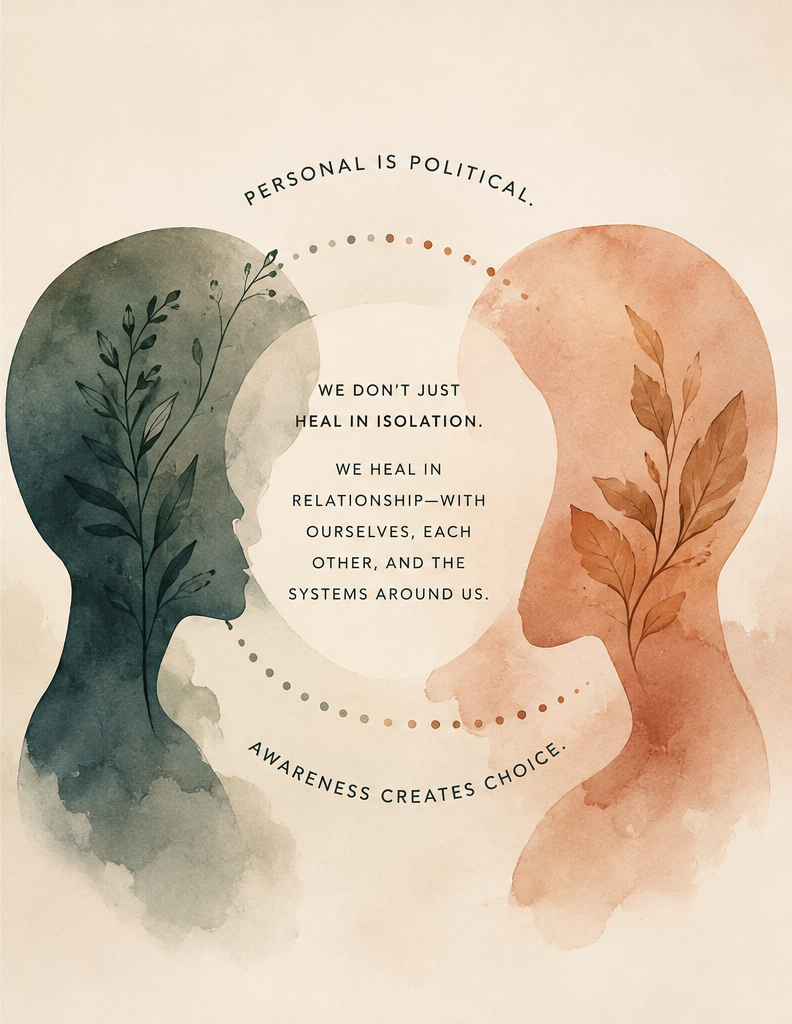
If your therapist says politics don't belong in therapy, they've already taken a political position.
There's a constant debate on social media asking a big question: Is therapy political?
The short answer is yes, and it matters that your therapist knows it.
Let me explain by looking at this from a few angles.
Hi, I'm Ryn Rising (they/them). I'm a mental health therapist licensed in Oregon and a coach worldwide. I support queer, trans, and neurodivergent folks, along with people navigating ethical non-monogamy, relationship stress, and moving out of the United States to build more authentic, sustainable lives.
What the "keep politics out of therapy" crowd gets right
When people say therapy shouldn't be a political space, I get it.
As I understand it, they mean you shouldn't have to share a political stance to get good help, and a therapist shouldn't try to change your views. I agree with that on a basic level.
What gets left out is the dialectical relationship between politics and everyday life, and the limits we accept when we ignore it.
Therapy is political because everything is political
Politics and mental health shape each other. Political structures, policies, economic conditions, and cultural norms create the conditions people live in.
Those conditions affect stress, safety, belonging, access to resources, and mental health.
At the same time, people's collective experiences of distress, resistance, adaptation, and organizing can challenge or reinforce those same structures.
You can't overlook how systems shape the way we think and behave.
So instead of treating anxiety or depression as only "what is happening inside this person," we can ask:
What is happening around this person, and how are those conditions becoming part of their psychological experience?

An example: who carries the mental load?
Here's a relationship stress I see often between heterosexual couples.
Picture a couple who keep fighting. She feels overwhelmed and resentful about managing the household.
He feels criticized, because he believes he "helps" whenever she asks.
On the surface, it looks like a communication problem.
She needs to state her needs better. He needs to listen better.
A gender-aware, dialectical approach asks a different question: what social norms have entered this relationship and shaped what each person believes a partner is supposed to do?
Many couples have absorbed a gendered division of labor in which:
She is expected to notice what needs to be done and anticipate everyone's needs.
Caregiving and emotional support are treated as feminine responsibilities.
He sees his role as paid work or discrete tasks.
She carries the mental load even when chores are technically "shared."
He feels he contributes a lot, because he completes the tasks he's been explicitly assigned.
The conflict isn't only between two individuals.
It's happening inside a relationship that exists inside a gendered social system.
The American Psychological Association has documented that women carry disproportionate responsibility for childcare, household management, and relationship maintenance, and has linked gender expectations and power imbalances to stress and mental health. APA Article
This is where "dialectical" gets useful. The pattern can be mapped like this:
Patriarchal norms → relationship expectations → unequal labor and power → relational stress → individual distress → relationship conflict
Then the arrow goes the other way:
Relationship behaviors → reinforce or challenge gender expectations → shape what each partner sees as "normal" → reproduce or disrupt those norms
The couple isn't simply affected by patriarchy.
Their everyday interactions can also reproduce, negotiate, resist, or transform it.
And it goes both ways
Say she becomes more exhausted and angry. He says, "You're always criticizing me," and withdraws.
She experiences his withdrawal as abandonment and takes over even more.
He experiences her taking over as proof she doesn't trust him, so he gets less involved.
She grows more resentful.
Eventually both are saying, "See? You're the problem."
But the pattern is being generated by individual histories, relationship dynamics, gender expectations, and broader social norms, all feeding back into one another.
That's a dialectical conceptualization.
Suffering is shaped by power
Racism, poverty, ableism, capitalism, patriarchy, state violence, transphobia, homophobia, economic stress, and criminalization directly affect mental health.
Treating distress without naming those systems falsely individualizes harm and protects the status quo.
That is not neutrality.
It is a political choice.
Therapy always reflects values, norms, and power.
The only question is whether it challenges oppression or quietly upholds it.
Therapists who say "politics don't belong in therapy" are most likely upholding harmful systems without saying so.
Sure, they can help with your relationship stress, but how much you can change stays within the confines of those systems.
They're more likely to promote adaptation when they could be promoting liberation and systemic change, one client at a time.
What changes when your therapist gets it
A therapist who considers this dialectic takes the "blame" for your stress off you.
You get a deeper understanding of how your political environment shaped the way you think and behave.
Politics touches our finances, relationships, children's development, jobs, education, and family systems.
For therapy to be truly apolitical, you couldn't talk about money, relationships, race, gender, sexuality, work, or family.
Sooo.... what would you talk about then?
Picture a session where you don't have to explain your queerness, defend your relationship structure, or justify why years of masking left you burned out.
Where "it's not you" is taken seriously, and the real questions become what has been asked of you and what you want instead.
That's what affirming counseling and coaching can feel like. No more shrinking to fit a system that was never built for you. You get room to exhale, unmask, and build a life that fits.
If that sounds like relief, I'd love to talk. I offer counseling for Oregon residents and coaching worldwide, and the first call is free. No pressure, no pitch, just a conversation with someone who gets it.
You're allowed to take a full breath.